Every January we see the same wave at studios we work with. Forty new faces in week one, twenty of them gone by Easter, ten left by autumn. One yoga studio in Brno we’ve been chatting with for three years runs the math at the end of every quarter, and the punchline is always the same: the marketing budget they spent in December was effectively a tax on people who weren’t going to stay anyway. Last year they switched to spending half of it on a Sunday brunch for existing members. Attendance in February went up.
Owners almost always frame this as a "we need more new clients" problem. The data tells a different story. The win you’re missing isn’t more bookings in January. It’s the ten or fifteen people from last year’s January wave who should still be on a mat next week, and aren’t.
This piece walks through what the numbers actually look like, why so many people drift away in the first three to six months, and what a 3-month client costs you compared to a 3-year client in plain money terms. Then we’ll look at the parts of Zenamu, namely attendance history, memberships, and credits and passes, that exist specifically to make consistency easier.
The hard data: how long do your members really stay?
Let’s start with data from the fitness industry. Compiled across different clubs and studios, a few patterns keep showing up.
Roughly half of new gym members quit within the first six months.1 Traditional health clubs hit an average annual retention around 71.4%, with personal-training studios doing slightly better.1 Average membership length is often quoted around 4–5 years, but the variance by club type is enormous. Industry reports and retention studies suggest that around 15% of members leave within the first 3 months, climbing to 30–35% by the six-month mark. After a year, a substantial portion never return.2
Add to that two well-known business findings:
Acquiring a new customer can cost up to five times more than retaining an existing one.3
and:
A small increase in retention, just a few percentage points, can boost profitability by dozens of percent.4
Translate that into something concrete: fighting for retention is not a "nice to have". It may be the single biggest lever you have in your business.
Why do so many people drop out? (And in most cases, it’s not about you)
Why does half of your new January crowd disappear by June? You probably recognize at least some of these reasons from your own experience.
A new client signs up after seeing someone on Instagram and tells themselves they’ll look like that in a month. They don’t. Disappointment sets in around week three. Or initial motivation gets replaced by reality (work, kids, fatigue), and if they haven’t built a specific habit yet, say Monday 6pm pilates and Wednesday 7am yoga, your studio quietly slips out of their mind. Or worse: they stop coming and nobody checks in. No email saying "we haven’t seen you in 3 weeks, are you okay?", no offer of an easier class, no gentle nudge. By the time you notice, they’ve already mentally moved on. And sometimes the class was just too hard, the vibe different than expected, or no one walked them through their first visit, and they never quite felt like part of the community.
The important part: most of these people are not leaving because they dislike you. They’re leaving because they don’t have enough support, structure, and feedback to make a new habit stick. That’s exactly where smart use of data and communication makes a difference.
A simple LTV model: 3-month client vs. 3-year client
Let’s put some numbers on it. A simplified example: monthly membership at 60 USD, the client comes on average once a week, billed monthly. We’ll ignore acquisition costs and inflation for now. The goal is to illustrate the principle.
The 3-month enthusiast stays for 3 months. LTV (lifetime value) is 3 × 60 USD = 180 USD. You probably spent money on Facebook or Google ads to get them in, invested time in their first visits, explained how your studio works, maybe walked them through Zenamu. And before you know it, they’re gone.
The "normal human" who stays for 3 years gives you 36 months. LTV is 36 × 60 USD = 2,160 USD. Difference? 1,980 USD on a single person.
Now imagine: instead of 20 clients who stay 3 months, you have 10 short-term clients and 10 who stay 3 years. Or you manage to push average membership length from 6 months closer to 12–18. On top of that, remember that new clients cost you more (ads, free trials, staff time, onboarding) than clients who already know your space, your instructors, and your app.3
Suddenly it’s very clear why people in business keep saying:
"Your most expensive client is the new one. Your most valuable client is the one who’s already with you."
What you can do about it: from "hunting" to caring
Knowing that retention is important isn’t enough. You need three things, and they’re not independent.
You need visibility into your data. How quickly do new clients drop off? When are the critical periods (3 months, 6 months)? How many people return after a break? Then you need a plan for how you support them: onboarding (first emails, explaining the system, recommended classes), a check-in after a few weeks ("how are you feeling in our studio?"), an offer of gentler or more suitable classes when you see attendance falling. And finally you need a system that lets you do this at scale. Writing to every inactive client by hand works for a short while, but it’s not sustainable past 50 or 60 active members.
This is where a booking and client management system can quietly become one of the most useful tools in your studio.
How Zenamu helps you improve retention
Most retention work isn’t one big initiative. It’s a handful of small, well-timed touches at the right point in a client’s journey, and the pieces below follow that journey from someone’s first class to the loyal regular who quietly pays you for years.
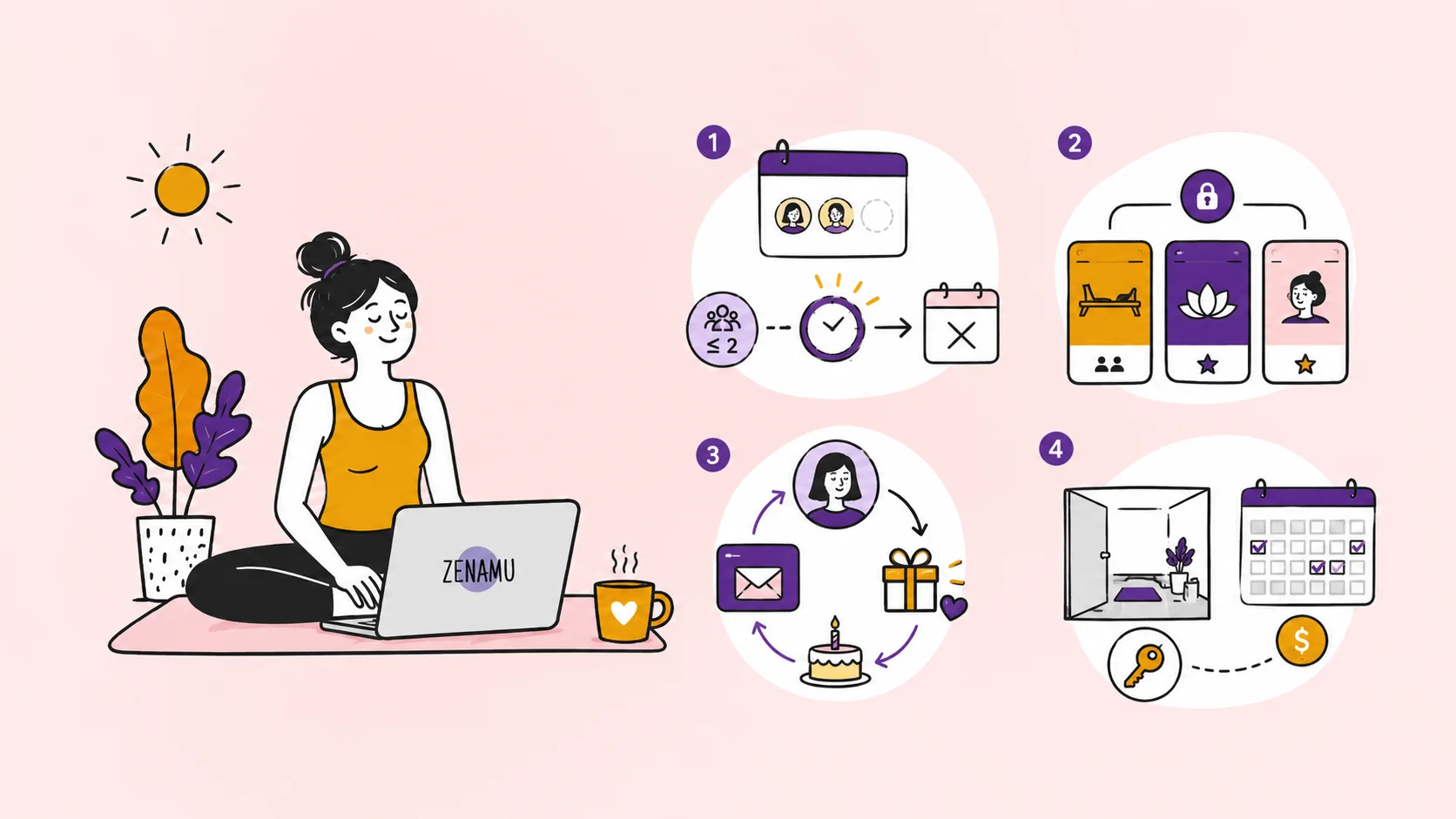
The window where someone decides whether your studio is "their place" is shorter than most owners think. By the third or fourth visit, they’ve either started slotting your class into their week or they’re already drifting. Zenamu’s memberships and credits and passes are the early-stage anchor here: a monthly plan priced fairly for one or two classes a week, or a small starter pack with a sensible validity window, gives someone permission to come back without overcommitting. The point isn’t to lock people in. It’s to remove the small friction ("do I really feel like booking again?") that quietly ends most beginner journeys. Tie that to clear class recommendations after a first visit, so a new client knows where to come back to rather than scrolling your full schedule. Every visit two through five roughly doubles the probability of visit six.
Then comes the critical drop-off window, month two through month six, where most of the damage happens. This is also where attendance data starts being useful. In Zenamu you can see attendance per client, per membership (how much of what they paid for they’re actually using), and per class type. A pattern usually shows up. One studio owner in Prague told us she always loses the same people: clients who book strong for four weeks, then miss two in a row, then never come back. Once she could see the second missed week the moment it happened, she started sending one sentence ("everything okay? our Tuesday 6pm has a spot for you if you want it"). Her stat on coming back went from below a quarter to closer to half.
What "acting" looks like is up to you. Some owners send a short, plainly-written email. Some recommend a gentler class. Some just mention the unused credits about to expire. None of it needs to feel like marketing; the most retention-positive message tends to be the one that doesn’t try to sell anything. If you’d rather automate that step, you can connect Zenamu’s client data to an email tool (see integrations and automations).
Once someone is past the first half-year, they’re usually in. What changes at this stage is the question you ask. "How many new clients did we get this month?" becomes "how many clients have been with us for six, twelve, or twenty-four months?" Marketing changes shape: fewer one-off campaigns, more depth for people already in the door. Schedules change shape too, with a regular weekly rhythm replacing seasonal launches. Conversations with instructors stop being about full classes and start being about which classes people return to. Zenamu sits behind all of this without trying to be the protagonist. It holds the membership renewals, the credit balances, the attendance history, the workshops that deepen the relationship with people who already trust you. You get the numbers to make decisions. The studio stays the studio.
Conclusion: your biggest opportunity is the people you already have
To sum it up briefly: industry data suggests that up to half of new members quit within six months,1 acquiring a new client is many times more expensive than keeping an existing one,3 even a small improvement in retention can lead to a big jump in profitability,4 and the difference between a 3-month client and a 3-year client can be thousands of dollars in lifetime value.
What you can influence is straightforward. Know your numbers: what does your retention look like after 3, 6, and 12 months? Have a care plan with onboarding, follow-ups, and a strategy for inactive clients. And use a system that makes this easier, like Zenamu. If you’d rather have all of this in one place (attendance history, membership setup, the small nudges that keep people coming back), that’s where Zenamu fits. It’s the boring infrastructure under a studio that retains its clients, not the show itself.